[Skip to Content]
 Visit us on YouTube View our RSS Feed
Visit us on YouTube View our RSS Feed Visit us on YouTube View our RSS Feed May
11

Posted by liaison on May 11th, 2026
Posted in: Funding
This is a guest post written by funding recipient, Merinda McLure. Merinda used NNLM Region 4 professional development funds to attend the AI² Summit a few weeks ago.
As March turned to April this spring, I was thrilled to receive NNLM Region 4 support to attend the AI2 Summit: Artificial Intelligence and Academic Innovation presented by the University of Florida, March 29–April 2, in Orlando, Florida.
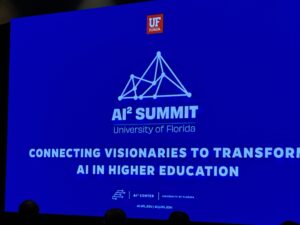 As the University of Colorado Boulder’s Health & Human Sciences Librarian, I’m busy working to keep pace with rapid developments in artificial intelligence (AI) and the related implications, challenges, and opportunities that AI presents for librarians, educators, researchers, and students. I correctly anticipated that attending AI2—with its specific focus on AI in higher education and the University of Florida’s reputation for its comprehensive attention to AI in higher education—would valuably support my learning.
The Summit sessions were organized in four tracks: building an AI university, AI in teaching and learning, infrastructure and innovation, and various AI topics. The spectrum of sessions addressed perspectives, experiences, initiatives, and case studies across higher education interests and concerns spanning AI in teaching and learning, related University policy and leadership, supporting faculty capacity and development, and more. Just a handful of the many take-aways that I’ve returned with include perspectives on ways in which AI has presented a need to revisit and develop approaches to evaluating student learning, and the increased importance of more transparent educator insight into and assessment of students’ learning and working processes, and not only their final course/program outcomes. In addition, the critical and enduring importance of developing students’ very human skills in communication, problem solving, critical thinking, and collaboration. Further, institutional-level, strategic considerations, such as amending existing university policies to account for AI, rather than creating new ones in such a rapidly changing and unpredictable environment; the importance of providing clear but also flexible guidance on responsible and ethical AI use for faculty and students; and the need to thoughtfully navigate tensions between decentralizing and centralizing AI tools and use guidance with consideration of costs but also academic units’ and disciplinary communities’ differing values, autonomy, and needs. Additionally, the need for faculty advocacy for and attention to the place of AI in disciplinary-specific learning, and the importance of continuous, hands-on faculty development that is mindful of educators’ exponential impact on student learning and experiences.
The AI2 Summit was a valuable learning opportunity, with a relatively small community of attendees from higher education across the U.S. and beyond, and one that I’d recommend for librarians seeking both broader, high-level perspectives on AI developments, policy and leadership considerations, and infrastructure in higher education, as well as presentations with a closer focus such as educator experiences and experiments in teaching, academic program/disciplinary initiatives, faculty development, and student learning experiences. I’m grateful to the NNLM Region 4 for supporting my learning.
