[Skip to Content]
 Visit us on YouTube View our RSS Feed
Visit us on YouTube View our RSS Feed Visit us on YouTube View our RSS Feed Jun
01

Posted by liaison on June 1st, 2026
Posted in: Funding
This is a guest post written by funding recipient, Evelyn Wang. Evelyn used NNLM Region 4 professional development funds to attend Assessing and Adopting AI Tools: A 2026 NISO Training Series. If you are interested in obtaining funding for professional development opportunities, we are currently accepting applications. Applications will be accepted and awarded on a rolling basis until January 2, 2027 at 5:00 pm MT or when the funds have been depleted. Please email region4@nnlm.gov with any questions you may have.
I work at the University of New Mexico Health Sciences and Informatics Center. I am a Clinical and Education Librarian serving UNMH residents, fellows, and research teams. As UNM begins to adopt and engage AI, and as clinical teams bring AI questions to the library, I see that AI is rapidly evolving and raises many questions and concerns. As a librarian, I know I need to grow in this area so I can better balance and shape the services and guidance I provide, and offer thoughtful perspectives and analysis on AI for my patrons.
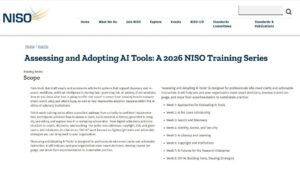 I participated in the NISO Training Series “Assessing and Adopting AI Tools,” held from March 26 to May 14, 2026. This eight‑week course covered approaches for evaluating AI tools; AI for open scholarship; search and discovery; identity, access, and security; AI literacy and learning; copyright and institutions; AI futures for the research enterprise; and DIY AI: building tools, shaping strategies.
Beyond the usual pros and cons of AI tools, I was curious how an eight‑week program like this could help me learn about AI across different research and expert perspectives, and how I might translate that into concrete ideas and recommendations for supporting clinical teams as a librarian.
In the first week, the speaker shared a framework for evaluating AI tools called FQS CPL, which includes F (Functionality), Q (Quality), S (Scale), C (Cost), P (Privacy), and L (Legal). Evaluating AI tools requires not only project managers, but also content experts who can review outputs and detect subtle differences.
In the second week, the speaker discussed how AI can support open scholarship by applying AI tools at the research data‑sharing stage to analyze datasets generated by research, take community norms and ethical constraints into account, and offer concrete action recommendations. The speaker also described how AI can help monitor the impact of post‑publication data reuse.
In the third week, the speaker encouraged moving beyond simple citation counts and highlighted Scite’s Smart Citation feature, which shows supporting, contrasting, or mentioning evidence to make research evidence more actionable.
In the fourth week, the speaker highlighted identity, access, and security issues, noting that outdated technologies such as IP authentication and EZproxy cannot adequately address AI bots accessing licensed content and may blur the line between automated activity and human patrons, leading to data pollution. The speaker also pointed out that as patrons increasingly rely on AI instead of directly using library platforms, zero‑click searching threatens usage‑based funding models, and that in the age of AI we need new metrics that focus more on quality than quantity, and distinguish between bots used for model training and intelligent agents acting on behalf of humans.
In the fifth week, the speaker emphasized that AI literacy is shifting from one‑way command input toward more collaborative, conversational interaction. Using metaliteracy as a framework for the AI era, the speaker highlighted cognitive (understanding mechanisms and limitations), behavioral (skills for using AI tools), metacognitive (reflecting on bias and search strategies), and affective (managing emotions and ethics in interactions) dimensions. The speaker also shared the Seekers Unbound game‑based learning model, designed to help students see themselves both as independent information seekers and as collaborators working with AI partners.
In the sixth week, the speaker explained that copyright is a set of exclusive rights granted to creators of original works, including the rights to reproduce, distribute, create derivative works, and publicly display them. Copyright is not permanent; under current standards it typically lasts for the life of the creator plus 70 years. Copyright protection applies to human creators, so works generated entirely by AI do not qualify for copyright, and because there are currently no clear laws or regulatory systems designed specifically to govern AI, many copyright disputes are still decided under existing copyright statutes. The speaker also used several examples to illustrate the concepts and principles of fair use in this context of AI.
In the seventh week, the speaker discussed the future of AI in scientific research and suggested shifting from prediction to strategic foresight, so organizations can more intentionally prepare for multiple possible futures. The speaker noted that libraries can use an impact‑versus‑difficulty matrix to review current strategic plans, identify blind spots, and prioritize high‑value initiatives. Future competitiveness will depend less on organizational size and more on whether institutions can successfully leverage AI to reinvent service models and reduce the unit cost of knowledge work.
In the eighth week, the speaker offered a rapid recap of the training series and highlighted “brain fry” as a new kind of fatigue and burnout associated with intensive AI use. The speaker also discussed how organizations might design collaboration models that encourage employees to use AI tools while still protecting time for rest and recovery.
After this eight‑week course, my understanding of AI is no longer only about supporting or opposing it. I am starting, from my library skills, to imagine new ideas about how AI tools and humans can interact. From a collection and resource acquisition perspective, I see the need for new frameworks to evaluate tools, to review their outputs, and to bring the role of content experts and peer review more clearly to the surface.
By connecting AI tools with research data and smart citations, I see more possible ways to collect and discover information and research data. AI tools can offer differing viewpoints and opposing evidence to expand our thinking, observation, and ability to assess information as we face an even larger ocean of information, following citation trails and data linkages.
As AI tools begin to shape how digital information is produced, managed, and accessed, they are also helping to build another kind of social structure in digital space. We need stronger systems for tracking, observing, and measuring, and new legal thinking and rules to guide and regulate this AI society.
Human responsibility is shifting from simply using digital information to governing digital social structures. Individually, we need deeper information literacy that can evolve into AI literacy. Collaboration no longer means only working with human; it also includes working with AI. Questions of how we train, regulate, and scale a large AI society are pushing humans to think about more strategic forms of management and leadership.
At a deeper level, an invisible pressure emerges: as AI tools grow more powerful, using them responsibly—and ethically—tests our most basic values. Greater power demands greater responsibility.
From the content and context of this course, I can see that humans are carefully, little by little, trying to protect this solid foundation of responsibility. As a librarian navigating information, I share in this obligation. When I support patrons in using AI tools to advance their research, this responsibility extends across all participants—myself, my patrons, and the AI systems with which we collaborate.
I am deeply grateful for this professional development opportunity provided by NNLM Region 4 and for the support of Dr. Melissa Rethlefsen, Director of the University of New Mexico, Health Sciences Library and Informatics Center, which made it possible for me to participated in the valuable learning experience.
