[Skip to Content]
 Visit us on YouTube View our RSS Feed
Visit us on YouTube View our RSS Feed Visit us on YouTube View our RSS Feed Mar
11

Posted by liaison on March 11th, 2026
Posted in: Funding
This is a guest post written by funding recipient, Sue Espe. Sue used NNLM Region 4 professional development funds to attend the 2026 ER&L Fest earlier this month.
 NNLM Region 4 at the University of Utah Spencer S. Eccles Health Sciences Library provided the funding opportunity to attend the Electronic Resources and Libraries annual conference. With much gratitude, I am grateful to the staff for their assistance and support of a grant for me to attend the 2026 ER&L Fest conference in-person, thank you. It was held in Austin, Texas on March 1 – 4 at the AT&T Hotel and Conference Center, located on The University of Texas at Austin campus.
Opening remarks to the conference were made by Whitney Bates-Gomez, the Program Planning Co-Chair. The opening keynote was presented by Robert H. McDonald titled Dawn of the Machine Age? Near Futures for Libraries and Higher Education. Robert is the Senior Vice Provost and Director of the University of Texas Libraries (UT Libraries) at The University of Texas at Austin.
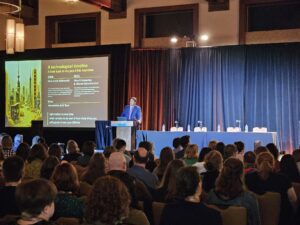 In this third keynote for Electronic Resources & Libraries, Robert delves into his previous presentations about Web 2.0, cloud computing and the technological development timeline of the past two decades. He delves further into the emergence of generative artificial intelligence and its anticipated impact upon many aspects of the library technological environment. He spoke about its relationship to projections of Ray Kurzweil in his book, The Singularity is Nearer When We Merge with AI.
Three case studies were presented in the session titled Breaking Up Isn’t That Hard to Do: Purchasing Articles on Demand. The presenters from three different academic institutions, Mitchell Scott, Cathy Austin and Gabrielle Wiersma, spoke about their experience migrating to a patron driven article acquisition product. They each provided practical tips, detailed cost savings, and highlighted outcomes. The user quote, “I’ll wait 30 seconds” found in a 2025 study, was the impetus for pursuing the change from moving away from the “big deals”. They were all able to demonstrate multi-year, qualified savings that positively reduced their overall budget.
From Authentication to Impact: Leveraging OpenAthens Data for Assessing Library Impact on Student Success was presented by Brian Erb from the Florida Virtual Campus Library Services and Shannon Dew from Florida State College. A representative from OpenAthens, James Edwards, Senior Business Development Manager, was also present. The presenters spoke about the ability of an OpenAthens API implementation that provides robust user logs accession data through a comprehensive data dashboard. Particularly useful data for increasing scrutiny of academic institution accreditors, the data dashboard offers in-depth and specifically granular data capabilities of library usage.
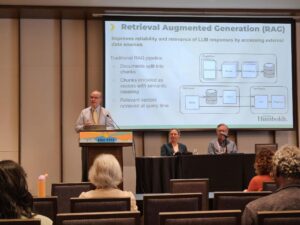 Certainly, AI was a major topic of discussion. One interesting and informative session was Uncharted Territory: Discovery in a Post-AI World. Anecdotally, there appears to be reduced usage of PDFs, exponential growth of citations gathered simply from AI-generated summaries, while full text usage declined.
Another hot topic revolved around article processing charges or APCs. Presenters Matthew Estill from the University of Pittsburgh and Lauren Collister with Invest in Open Infrastructure presented the eye-catching session It Feels Like Legalized Extortion: How R! Authors Experience the APC Trap and What Libraries Can Do To Help. Their results were categorized into nine themes of financial concern, diversity or equity, threshold of reasonableness, restriction of decisions, grants don’t cut it, academic obligations, academic labor and quality or rigor. They found that “most APC funding flows through grants and research offices, not libraries; research administrators and grant managers are key partners; work together on grant budget guidance for APCs; advocate for funder policies that adequately cover OA costs; connect authors to fee waivers and Diamond OA options before they commit to a journal.”
And “Beyond Paying Fees – Advocating for Change: Transformative agreements and library funds obscure costs – they don’t eliminate them; Diamond OA & S20 models exist and work but they need our support; open source infrastructure offers sustainable, community-owned alternatives; authors in this study recognized the inequity and we should amplify that; use this data to make the case internally and externally for sustainable OA.”
Overall, they found that 84% of survey respondents “said fees less than or equal to $1,500 were reasonable. Current APCs have already surpassed the threshold of reasonableness and $1,500 is a data-backed benchmark for negotiations and advocacy.” All surveys and the corresponding data can be found on GitHub.
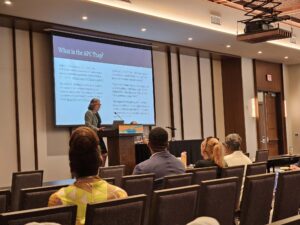 Respondents remarked in the open-ended area of the survey, stating that “I don’t like the model where researchers pay a lot (in some journals) to publish their work – it creates bad incentives to publish bad research in some cases, and makes it so people with less financial backing cannot have their papers easily accessible.” Several other studies about APCs were notable.
The ER&L sessions provide invaluable information, presented by knowledgeable presenters who graciously shared their knowledge, tips and practical guidance. Topics covered by presenters are very relevant and important for any librarian to remain current in all aspects of the industry. Several key takeaways about APC will be discussed with stakeholders and our authors, along with potential utilization of transformative agreements, as we further balance publication acquisitions with cost savings in our healthcare organization. In addition, costs associated with subscription agents and article acquisitions will be reviewed closely. I have a heightened sense of AI integrations, its citation hallucinations and how users may only cite summaries without reading the full text, which may be reflected in annual usage data. The publishing field and information sciences continue to be associated with quickly changing dynamics, along with increasing costs.
