From Nursing to Librarianship
Posted by Carolyn Martin on December 3rd, 2025
Posted in: Guest Post, Medical Librarians
Tags: librarian roles, libraries, medical librarian
Though National Medical Librarians Month has passed, we are continuing to celebrate the medical librarians in the NNLM Region 5. We thank Frances Chu, Medical Librarian at Providence Health & Services, for sharing her career journey.
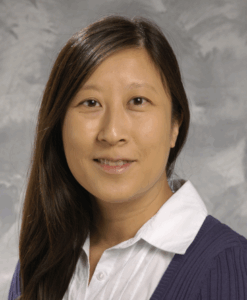 Why become a librarian? That is a question that has been asked of me since becoming a librarian in 2006. In all honesty, I was trying to find out more about informatics. In the early 2000s, as health professionals were becoming more aware of electronic health records, I wanted to learn more about these systems. Unfortunately, there was no training for health professionals, so I took computer programming classes. At the local community college, a counselor suggested I apply for library and information science program to gain knowledge about information science. However, after graduating, I ended up working as a health sciences/medical librarian. After all, I am nurse. I did have experience searching PubMed (thank you NNLM for providing training!) as a research assistant, but becoming a librarian was not in my mind. However, after becoming a librarian, I realized that I really enjoyed the role.
I started out working at a competitive intelligence company targeting pharmaceutical companies and then transitioned to a pharmaceutical company. After being laid off (typical for special libraries), I ended up in academic libraries. I enjoyed both academic libraries and special libraries. There are pros and cons to working in both areas. Since 2022, I have been back in special libraries. Specifically, I work as a medical librarian for a hospital system. I am back to searching for information for clients and providing training for clients on searching and information literacy. Now that I have a PhD with a focus on implementation science, I try to work with the nurse scientists on designing, developing, and implementing research projects in addition to evidence-based practice and quality improvement projects. I try to bring implementation science principles to the projects, and I continue to get training on implementation in the hope that people will think about implementing outcomes in addition to service and patient outcomes.
In the end, health sciences/medical librarians and all librarians need to prove our worth. This was a dilemma in nursing in the 90s when hospitals attempted to replace registered nurses with patient care technicians/nurses’ aides. However, nursing researchers showed that not having registered nurses led to poorer patient outcomes and increased patient mortality. Although librarians may not be able to directly tie our services to patients, we can tie our service outcomes to metrics of interest to hospitals. I look forward to remaining librarian until retirement, and I hope to collaborate with librarians and other professionals interested in research.
 ABOUT Carolyn Martin
Carolyn Martin is the Outreach and Education Coordinator for the NNLM Region 5. She works with various libraries and community organizations to increase health literacy in their communities.
Email author
View all posts by Carolyn Martin
 Visit us on Facebook