Health Literacy for All
Posted by Carolyn Martin on October 12th, 2026
Posted in: Consumer Health, Guest Post, Health Literacy, News from Network Members
Tags: consumer health, health literacy, librarian roles, libraries, National Health Observances
We thank Susan Banks for this wonderful post about choosing to bring awareness and education to the public about the quality health information resources. On her own she plays an important role in improving individual and organizational health literacy. She reaches out to libraries and organizations nearby to emphasize how important health literacy is for healthy individuals and communities.
Students attending academic institutions have built-in opportunities to learn information literacy skills. But where and how does the public learn to search, evaluate, and use information, particularly in the healthcare arena? Navigating the ever shifting World Wide Web is challenging even for information professionals, especially with the rapid emergence of AI.
After a long and rewarding career at Bastyr University (BU), I decided to leave in 2023, not long before AI became pervasive. BU, located on the north end of Lake Washington, offers degrees in the natural health arts and sciences. Because databases such as PubMed are structured around conventional medicine, our students needed better-than-average search skills. For that reason and because one-off sessions were inconsistent, I helped develop a formal information literacy program for all degrees. Introductory and advanced workshops were targeted to research-oriented classes in which librarians taught both transferable and targeted skills aimed at required coursework.
Outside the structured university setting, I often found myself in the company of people flummoxed with questions about searching the Web for health information: how do I know whether the information is credible, where and how should I search? Why can’t I just use AI? Complex questions about herbal/dietary supplements also arose: do they really work? Which ones should I buy? Are they safe?
I still enjoy doing research and could have answered the questions, but not in a matter of a few sentences and without risk of putting people to sleep. Eventually, an idea formed, and I decided to create classes to reach people who wanted to learn health information literacy skills.
The first one, How to Find, Evaluate and Use Health Information, had fairly straightforward content with an ambitious goal: to teach participants how to find, evaluate and use health resources to make informed decisions to better manage their health.
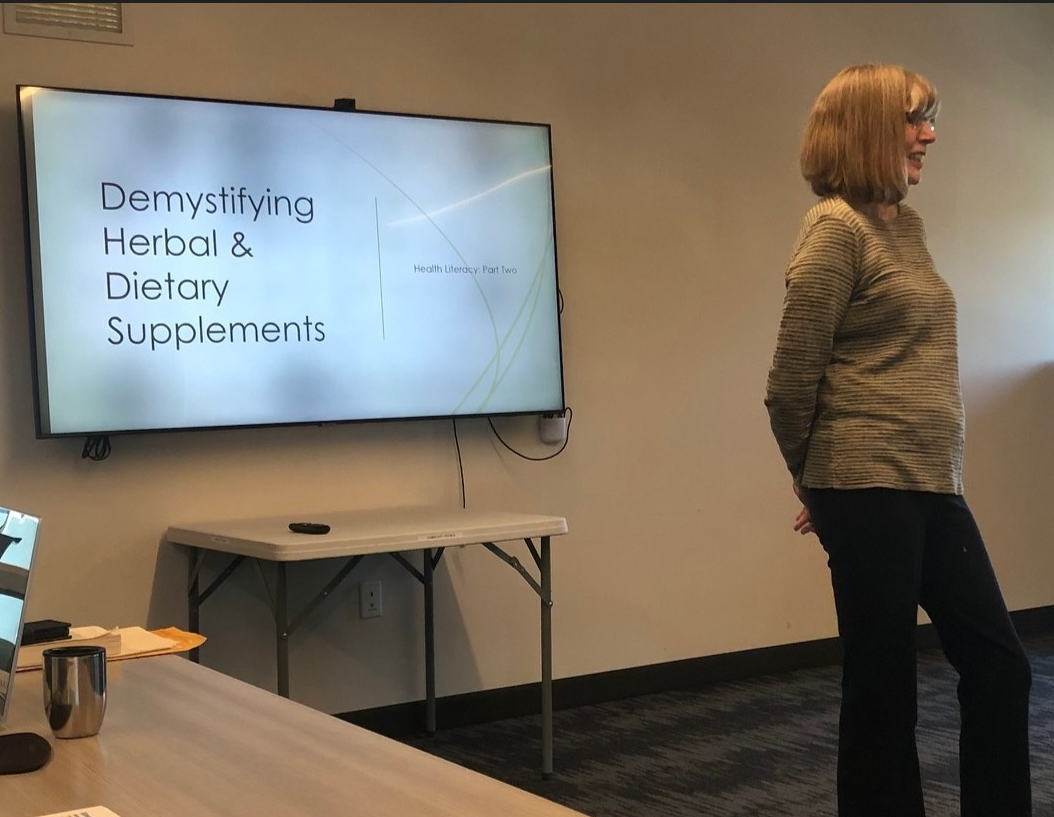
Susan teaching, “Demystifying Herbal and Dietary Supplements” information class at the Edmonds Waterfront Center
The second, Demystifying Herbal and Dietary Supplements, was complicated. Although dietary supplements are widely used (about 75% of the population in the US), they are not well understood. I began every class with a disclaimer making it clear that I was not a practitioner and would not give advice about the use of dietary supplements for health conditions. My goal was to teach participants how to find the research relating to efficacy, and the last half of the class focused on tools to evaluate the quality of the 100,000 and counting products on the market. For example, Seattle Public Library subscribes to ConsumerLab database that provides independent test results for popular supplements and food products.
Participants in my classes range from five to 22. For each one, I created a PowerPoint, handout/Google Site to upload them, an icebreaker or knowledge check, and when appropriate, an evaluation. The sessions are 1.5 hours with the first hour for my presentation and the last 30 minutes for participants to practice what they’ve learned and to ask additional questions. As it turns out, they do want to learn and not one person has fallen asleep.
Challenges:
- Marketing my classes, which has been primarily to senior activity centers, has been difficult. Oftentimes I don’t get a response. Early on, despite sending my class outline and handout, some program coordinators thought I was selling insurance.
- In academia, coursework is structured. You know when and within what classes information literacy skills will be taught. Non-profit organizations usually schedule several months in advance and they don’t always have space available for new classes. In addition, the level and quality of marketing varies.
- Keeping class content current has always been challenging and magnified now that I’m no longer affiliated with a university library system.
Positive Outcomes:
- Evaluations have been positive and the level of engagement encouraging. Most if not all of the information I present is new to participants and generates interest and excitement.
- A retired physician advocating for health literacy classes in the k-12 system attended several of my classes. In consultation with him, I found studies for his proposal demonstrating that better health literacy skills improve health outcomes.
- I was invited by a librarian at a public library to teach a short session to staff about MedlinePlus. A date has yet to be set, but in my experience, the wheels move slowly.
Although I no longer work at a university library, I have found a home at PNC/MLA (Pacific Northwest Chapter of the Medical Library Association) and still have colleagues. About the time I started my program, Ekaterini Papadopoulou, then president of PNC, advocated for it to be open to anyone in the library profession. In particular I’d like to give a shoutout to her and to Basia Delawska-Elliott, librarian at Providence Library Services, who kindly shared the content of a similar class she was teaching to staff. Also, thank you to Carolyn Martin, Outreach and Education coordinator for Region 5, who has supported me since I began the program.
Teaching health literacy skills to the public has been challenging and gratifying. I’ve considered creating a third class but haven’t hit on a topic yet. Thanks to all who have supported me. I welcome your comments and suggestions.
 ABOUT Carolyn Martin
Carolyn Martin is the Outreach and Education Coordinator for the NNLM Region 5. She works with various libraries and community organizations to increase health literacy in their communities.
Email author
View all posts by Carolyn Martin
 Visit us on Facebook