Creating a New Format for AI Literacy Instruction
Posted by Carolyn Martin on April 1st, 2026
Posted in: Education, Guest Post, News from Network Members
Tags: AI, AI Literacy, conference, librarian roles, professional development, Technology
We thank both Morgan Choate and Katie Jefferson, from the Savitt Medical Library at the University of Nevada, Reno. Morgan is the Clinical and Instruction Librarian and Katie is Head of Public Services and Liaison Librarian. Their post shares the creative and engaging immersion session they presented about AI at the MLGSCA/NCNMLG 2026 Joint Meeting.
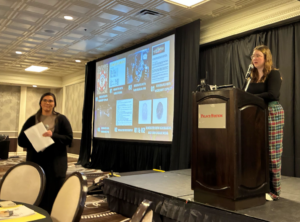
Katie (left) and Morgan presenting at the MLGSCA/NCNMLG 2026 Joint Meeting
Have you ever played a take-home murder mystery game? It’s typically composed of physical items and paper clues players follow in hopes of solving a fictional murder. Almost like a detective role-playing game. These types of games served as a major inspiration for our immersion session at the Northern California and Nevada Medical Library Group (NCNMLG) and Medical Library Group of Southern California and Arizona (MLGSCA) joint meeting in Las Vegas in January. Our thought was: if these games are engaging and provide a built-in opportunity for teamwork, why not use this format for Artificial Intelligence (AI) literacy conversations?
A major issue we noticed in the instruction of AI literacy is the use of lecture-based sessions that employ highly technological language to get the point across. While this is the tried-and-true format used in higher education, this method is just not compatible with the diverse learning and information processing styles found at libraries and among librarians. Thus, the thought of using a fun and interactive game that attendees want to be involved with and participate in was the ideal method.
The design was relatively simple in terms of adapting a murder mystery game to discuss AI literacy, specifically the detection of Generative AI use. We thought of a scenario to solve, relevant to the conference location, and devised vague clue types that could be used in this situation. As opposed to a murder mystery, we landed on the heist of a Las Vegas casino vault. The clues we provided included an evidence photo, a hotel receipt, convenience store security camera footage, a news article about the heist, a 9-1-1 call transcript, road camera footage, and individual criminal records with fingerprints. From here, we created a narrative of where the “suspect” went and when for the participants to follow.
For each clue, we took on the task of finding a “real” version (human created to the best of our knowledge, we usually found these via real-life news platforms or public access cameras) and a “fake” version (using Generative AI). In the session itself, we provided the participants with a case file and challenged them to detect and distinguish which clues were “real” and then solve the case based on these real clues in 45 minutes. Our overarching theses of this activity being:
- Generative AI models have gotten so good that detection is no longer a given and
- retroactive intervention in unethical AI use may not be possible soon.
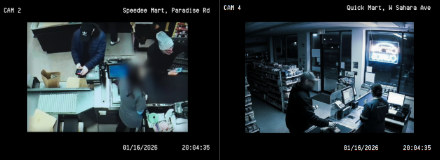
Which image is real? The image on the right is AI generated.
While this session was not perfect, it went overwhelmingly well. It was our team’s first time creating anything like this, so there were some plot holes and instruction clarity issues, but everyone seemed to have a fun while doing it at the very least. One participant even told us that getting the clues wrong felt more effective to the activity than getting them right as it truly proved how realistic Generative AI outputs can get nowadays.
If we were to conduct this session again, which we hope to, one thing we would change is the instructions. It is important to communicate the overall expectations of the session to all participants and ensure a non-competitive environment is cultivated. Some participants will immediately lean into the implied competitive nature of a game with a timer, but the ultimate goal is learning, not winning. Additionally, we may have overcomplicated it by making participants not only solve who the suspect was, but also what location they were hiding in using clues that provide directions. Next time, we will consider only asking for one of these types of answers to limit confusion of participants.
We greatly encourage you to try something like this for your library or institution! AI literacy is now depending on many of us, and we have to find creative ways to get the information across. This was just our attempt at doing so. If you are interested in adapting this idea, feel free to email either of us (Morgan and Katie)! We have all of our materials for this session saved digitally but can also talk you through what prompts we used for the Generative AI clues.
 ABOUT Carolyn Martin
Carolyn Martin is the Outreach and Education Coordinator for the NNLM Region 5. She works with various libraries and community organizations to increase health literacy in their communities.
Email author
View all posts by Carolyn Martin
 Visit us on Facebook