[Skip to Content]
 Visit us on YouTube View our RSS Feed
Visit us on YouTube View our RSS Feed Visit us on YouTube View our RSS Feed Aug
12

Posted by liaison on August 12th, 2026
Posted in: All Members
This guest post was written by Juli Tracy. Juli is a registered dietician and MLIS graduate student who graduates this month. She served as a practicum student with the Network of the National Library of Medicine’s Training Office.
This summer, I had the opportunity to complete a 12-week field experience with the Network of the National Library of Medicine’s National Training Office (NNLM NTO). The experience allowed me to bring together two important parts of my professional journey: my background in nutrition, public health, and education and my emerging career in library and information science.
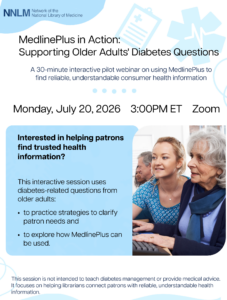 My primary project was developing and delivering an interactive pilot webinar for public librarians titled MedlinePlus in Action: Supporting Older Adults with Diabetes Questions. The 30-minute session explored how public librarians can use MedlinePlus to assist older adult patrons seeking diabetes-related information. It also emphasized an important professional boundary: librarians can help patrons locate and understand reliable health information without interpreting symptoms or providing medical advice.
Creating the webinar gave me the opportunity to participate in every stage of instructional program development. I identified the needs of the audience, developed learning objectives, organized the content, incorporated polls and patron scenarios, created an accessible promotional flyer and slide presentation, and designed a participant evaluation in Qualtrics. Because the session was developed as an interactive pilot, participant and colleague feedback was an essential part of the process.
Participants responded especially positively to the guided patron scenario and the “Clarify, Locate, Connect” framework for approaching health reference questions. Their feedback also helped me identify ways the webinar could be strengthened, including allowing more time for discussion, providing additional live demonstrations of the MedlinePlus website, and expanding opportunities for participants to practice. This process reminded me that effective instruction is not finished when a presentation ends. Evaluation and reflection are important steps in improving a program and ensuring that it meets learners’ needs.
Accessibility was another important part of my experience. I became more intentional about using readable layouts, checking color contrast, adding alternative text, and considering accessibility from the beginning of the design process. These practices reinforced the importance of creating learning materials that are welcoming and usable for the widest possible audience.
Throughout the practicum, I also benefited from the knowledge and encouragement of my NTO supervisor and colleagues. Librarians with expertise in instruction, assessment, communications, and technology provided valuable feedback as I developed the webinar. Informational interviews with NNLM and health sciences librarians across the country further expanded my understanding of the many ways librarians support health literacy, education, research, and community engagement.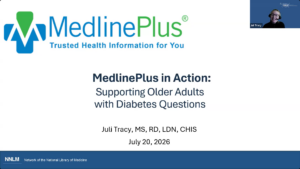
This field experience confirmed that my previous work in healthcare and education can transfer meaningfully into librarianship. It strengthened my interest in consumer health information, instructional design, and professional development for public librarians. Most importantly, it reinforced my belief that librarians play a vital role in connecting people with credible, understandable, and accessible health information.
I am grateful to the NNLM National Training Office for providing such a welcoming, collaborative, and meaningful learning experience. I look forward to carrying the skills, professional relationships, and lessons from this practicum into the next stage of my career.
