Typhoons and Hurricanes: Emergency Preparedness and Recovery
Posted by Emily Hamstra on March 12th, 2026
Posted in: Emergency Preparedness
Tags: disaster information, disaster preparedness
Did you know that tropical cyclones are called either a “typhoon” or “hurricane” based on their location? In the Central and Eastern North Pacific Ocean, the word hurricane is used to describe a tropical cyclone, while in the Northwestern North Pacific, the word typhoon is used. These storms produce wind speeds between 74 and 157 mph, impacting coastal areas and inland coastal regions with heavy wind, torrential rainfall, and flooding. In recent years, these storms have had a devastating impact on Region 5 locations, such as Typhoon Halong in Alaska (October 2025) and Typhoon Mawar in Guam and the Northern Mariana Islands (May 2023).
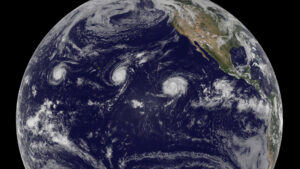
Storms Kilo, Ignacio, and Jimena near Hawaii, 2015. Photo from NASA: https://svs.gsfc.nasa.gov/11930/#media_group_336714
Start Here
Preparing for a Hurricane or Typhoon
To prepare for a typhoon or hurricane, create an emergency preparedness kit for your household (Ready.gov provides a list of supplies to stock in your kit). These storms produce high winds, so secure or bring inside items that could blow around easily, such as lawn chairs, grills, and garbage cans. The National Weather Services provides additional considerations for preparing your family and home for a hurricane.
As a hurricane or typhoon approaches, listen closely to news about the approaching storm. Know your hurricane evacuation plan and follow your plan if instructed to evacuate. Pay attention to news about a hurricane watch or warning. A Hurricane Watch is issued when sustained winds of 74 mph or higher are possible within the specified area of the Watch. Because hurricane preparedness activities become difficult once winds reach tropical storm force, the Watch is issued 48 hours in advance of the onset of tropical storm force winds. A Hurricane Warning is issued when sustained winds of 74 mph or higher are expected somewhere within the specified area of the Warning. Because hurricane preparedness activities become difficult once winds reach tropical storm force, the Warning is issued 36 hours in advance of the onset of tropical storm force winds. Learn more from the National Oceanic and Atmospheric Administration (NOAA): What is the difference between a hurricane watch and a warning?
During a Hurricane or Typhoon
Stay protected during a storm by:
- evacuating if ordered or avoid travel if not ordered to evacuate
- sheltering in places safe from water and wind
- paying attention to weather updates
- remembering that impacts can be felt far from the coast
Learn more: NOAA, Stay Protected During Storms; Ready.gov Hurricanes: Stay Safe During a Hurricane
After a Hurricane or Typhoon
Use caution, remembering that emergency service might not be readily available:
- if evacuated, return home only when allowed to do so
- don’t walk or drive through floodwaters, as they might be deeper than anticipated
- check in on your neighbors
- stay alert to dangers such as downed powerlines, gas leaks, and building structure issues
- when cleaning up, wear protective clothing and work with a buddy
Learn more: NOAA: Use Caution after Storms; Ready.gov Hurricanes: Returning Home After a Hurricane
 ABOUT Emily Hamstra
Emily Hamstra is the Assistant Director of NNLM Region 5.
Email author
View all posts by Emily Hamstra
 Visit us on Facebook