[Skip to Content]
 Visit us on Facebook View our RSS Feed
Visit us on Facebook View our RSS Feed Visit us on Facebook View our RSS Feed Jan
12

Posted by Nora Barnett on January 12th, 2026
Posted in: Blog
Tags: National Radon Action Month
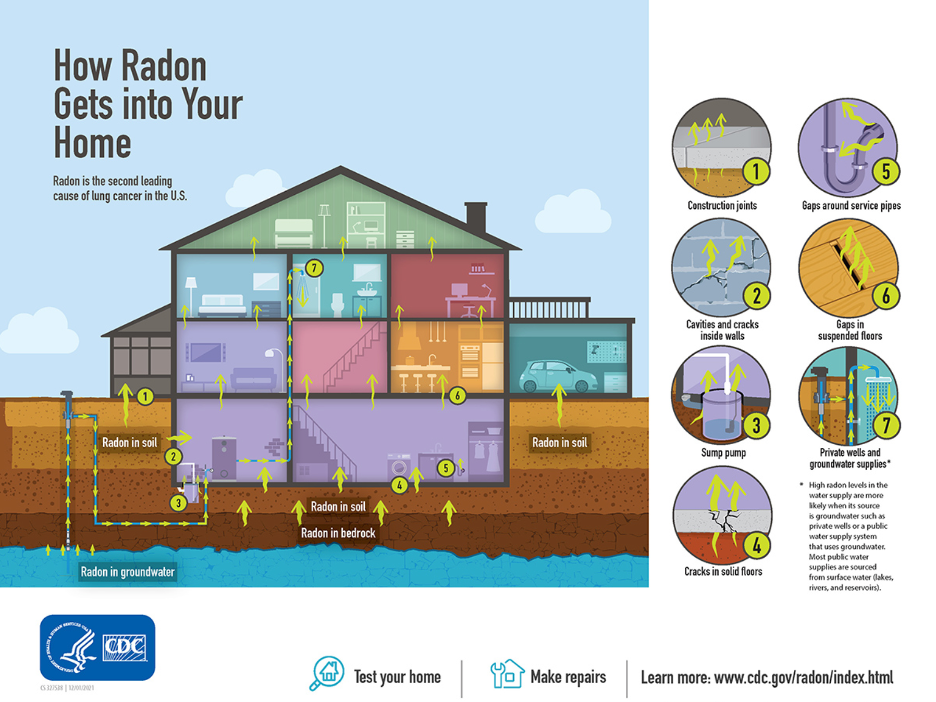
Radon is something many people have heard of but don’t know much about. Read on to learn more about what it is and why it matters. At the end is a list of resources and information about getting free test kits.
What is radon?
Radon is a radioactive gas that comes from soil, rocks, and water. You cannot see, taste, or smell it. Radon can enter a building through cracks in walls, basement floors, foundations, and other openings, and in some cases through well water. The EPA estimates that 1 in 15 homes in the US have high levels of radon.
How is radon related to health?
Exposure to high levels of radon can cause lung cancer. Radon exposure is the leading cause of lung cancer for people who have never smoked. People who smoke and are exposed to radon are at an even greater risk of lung cancer.
How do I know if my home has high radon levels?
The only way to know if a home has high radon levels is by testing, because radon can be present at high levels in any state, and even vary between neighboring houses. Any home may have high radon levels, whether the home is new or old, well-sealed or drafty, and whether it has a basement or not.
Testing is simple and inexpensive. You can:
Radon test kits are available at many local health departments, hardware stores, home improvement stores, and other retailers. You can order a test kit here.
What do results mean?
Radon is measured in picocuries per liter (pCi/L) of air. The EPA recommends reducing radon if levels are 4.0 pCi/L or higher and considering reducing radon if levels are between 2.0 and 4.0 pCi/L. The goal is to lower radon to the lowest level possible.
What do I do if my home has high levels of radon?
You can reduce and prevent radon problems by:
This information comes from the American Lung Association and the Environmental Protection Agency.
Environmental Protection Agency
The Environmental Protection Agency (EPA) Radon page hosts information ranging from the basics to more specialized, in-depth information. Learn about the health risks of radon, read about how to reduce your risk and exposure to radon, and view frequently asked questions. Find guidance for schools, the real estate community, and new homebuilders. You can also find standards of practice for radon professionals, the National Radon Action Plan, and information on state and tribal indoor radon grants.
At the EPA’s National Radon Action Month page, learn about testing your home and find EPA’s free radon publications, including Basic Radon Facts and A Citizen’s Guide to Radon: The Guide to Protecting Yourself and Your Family from Radon
American Lung Association
The American Lung Association (ALA) has a wealth of information about radon. Find radon resources for health professionals (including a video, a decision support tool, and patient handouts), real estate professionals, people who work in schools, and advocates and decision makers.
At the ALA Radon page, order a radon test kit, learn about radon testing disparities, and watch a short (under two minutes) video about radon and lung health, available in English and Spanish. You can also take Radon Basics, a free one-hour interactive online learning program.
National Cancer Institute
The National Cancer Institute’s Radon and Cancer page includes questions and answers about the link between radon and cancer.
National Institute of Environmental Health Sciences
National Institute of Environmental Health Sciences (NIEHS) supports research on exposure to radon, its health effects, and ways to raise community awareness of radon risk. Scroll down the NIEHS Radon page to learn about the research supported by NIEHS.
PubMed
For those wanting to explore the research literature further, head over to PubMed. Radon is a MeSH term. Enter radon in the main search box or find it the MeSH database, where you can add it to your search builder with subheadings and see where it is located on the MeSH tree.
Centers for Disease Control and Prevention
CDC has designated January 26-30, 2026 as Radon Awareness Week. This year’s theme is “What’s Your Radon Story?” Each day of the week will feature facts about radon with related graphics, social media messages, and a highlighted radon story.
Health professionals, check out CDC’s Radon Communications Toolkit, which includes shareable social media messages, shareable images, and print materials such as the Talk to Your Patients About Radon decision tree and the Test Your Home for Radon factsheet.
Free radon test kits are often available through state or local public health departments, especially during the month of January. Check with your local or state public health department or state radon office to see what free test kits are offered. Find your state radon office here.
 ABOUT Nora Barnett